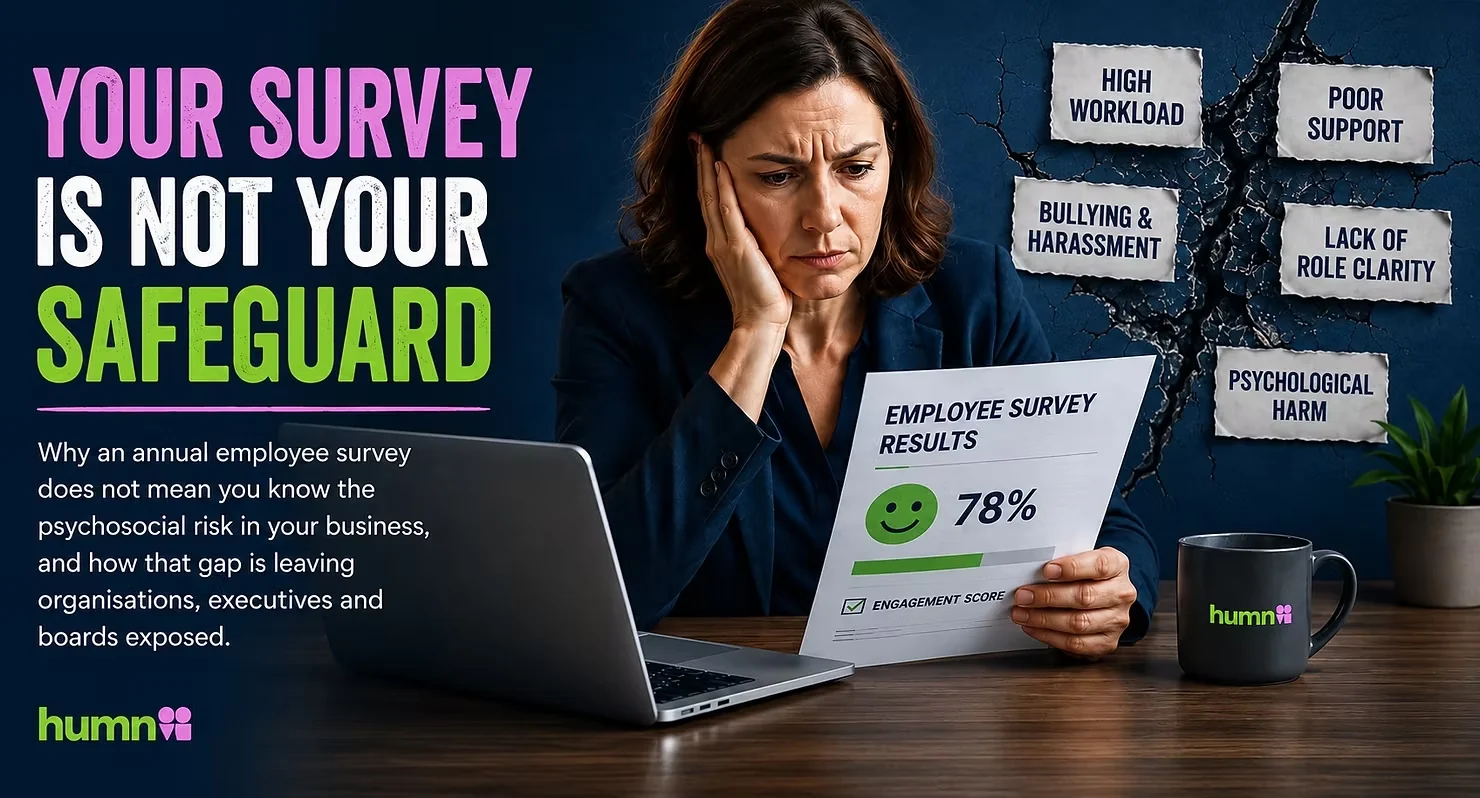
Your engagement survey is not your safeguard for Psychosocial Risk Assessments.
Why annual employee surveys are creating a false sense of security.
There is a comfortable assumption taking hold in many organisations today and it goes something like this. We run an annual employee survey, we receive an engagement score, the results are reported to the executive and board, and therefore the assumption is 'we understand our psychosocial risk'.
It is an appealing proposition. Surveys are relatively inexpensive, familiar to leaders and often produce neat dashboards that create the impression of insight and control. Unfortunately, they can also create a false sense of security.
The challenge is not that employee surveys lack value. Many provide useful information about workforce sentiment, engagement, leadership effectiveness and organisational culture. The problem arises when organisations mistake that information for a psychosocial risk assessment, or worse, evidence that psychosocial risk is being effectively managed.
They are not the same thing.
Perception versus risk management
An engagement survey measures what people are willing and able to tell you at a particular point in time.
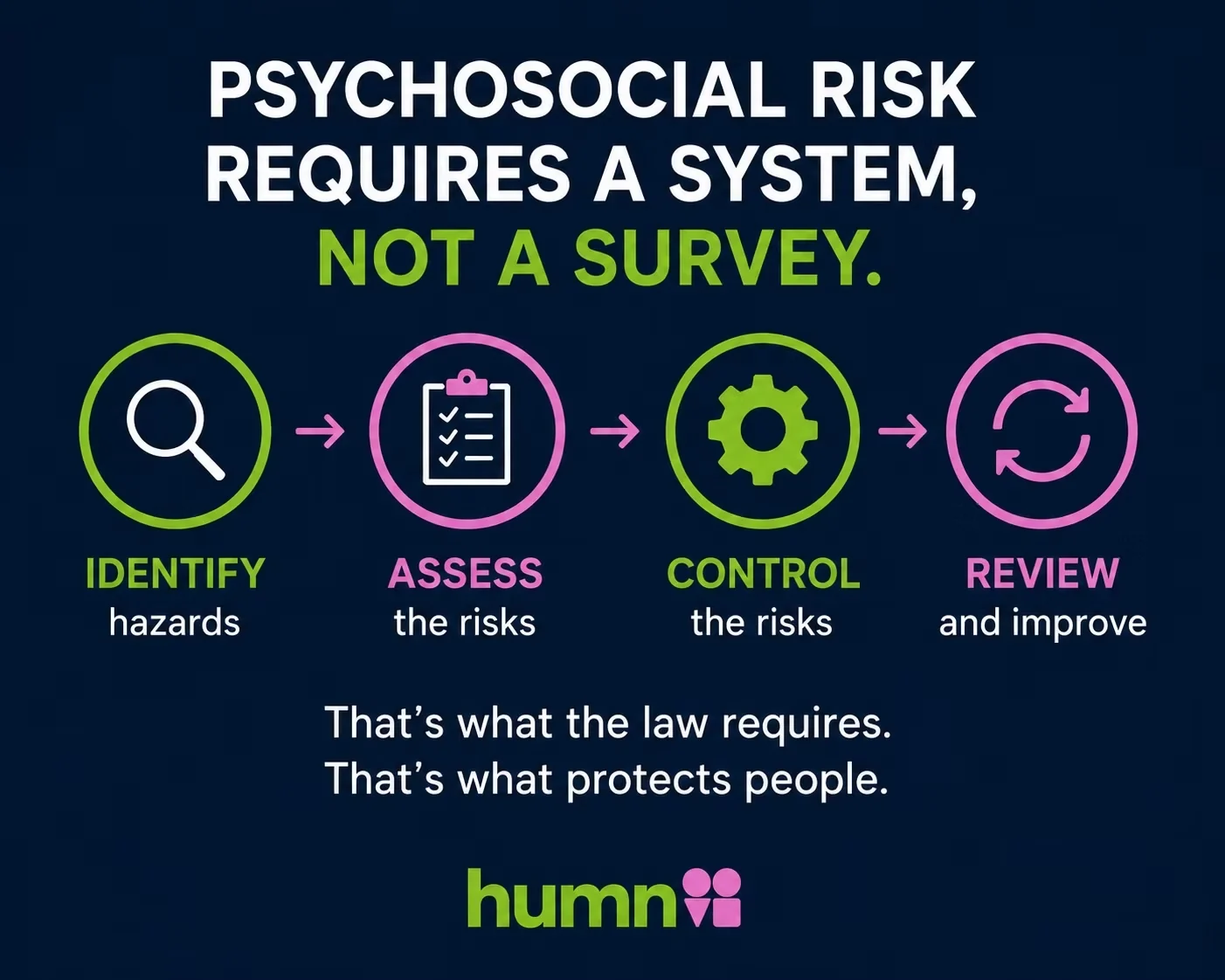
Psychosocial risk management requires organisations to identify hazards, assess the risks they create, implement controls and evaluate whether those controls are reducing exposure over time.
One is a perception tool. The other is risk management discipline.
An engagement survey is not a risk assessment, and it is not evidence.
What regulators are actually asking
This distinction is becoming increasingly important as psychosocial risk matures from a wellbeing conversation into a governance, legal and operational issue. Across Australia, regulators are not asking organisations whether they have conducted an employee survey. They are asking whether psychosocial hazards have been identified, whether risks have been assessed, what controls have been implemented and how organisations know those controls are working.
A positive engagement score does not answer those questions.
The duty the law actually sets: identify, assess, control, review.
What the engagement surveys miss
One of the limitations of engagement surveys is that they tend to capture symptoms rather than causes.
A workforce may report high levels of stress, fatigue or disengagement, but those results rarely identify, with any precision, whether the underlying driver is excessive workload, poor support, role ambiguity, poorly managed organisational change, job insecurity, exposure to traumatic events, or some combination of factors. Understanding that people are struggling is important, understanding why they are struggling is where risk management begins.
Engagement surveys also struggle to identify hazards that people do not feel safe reporting. Bullying, harassment, sexual harassment and inappropriate leadership behaviours are consistently underreported in workplaces, particularly where trust is low or where individuals fear repercussions.
Australian Human Rights Commission, Time for respect: Fifth national survey on sexual harassment in Australian workplaces (2022) highlights that one in three workers (33 per cent) reported experiencing workplace sexual harassment in the previous five years, yet only 18 per cent of those who experienced it made a formal report or complaint. If people will not raise these behaviours through the formal channels established for exactly that purpose, an anonymous engagement survey is even less likely to surface them. Some of the most significant psychosocial risks within an organisation can therefore remain hidden beneath what appears to be a healthy organisational score.
Another challenge is the way survey data is commonly reported. Organisational averages often conceal the very risks boards and executives need to understand. An organisation may achieve a strong overall engagement result while a particular team, location or business unit is experiencing significant psychosocial harm. The board sees a positive headline number.
The underlying exposure remains invisible.
Perception is not protection.
Would your assessment stand up to scrutiny?
From a governance perspective, perhaps the most important question is whether an employee survey would stand up as evidence if a regulator requested proof that psychosocial risks were being managed.
Imagine being asked to demonstrate how psychosocial hazards were identified, how risks were assessed, what controls were implemented and how their effectiveness was monitored and reviewed. An engagement survey report may contribute to part of that story, but it is unlikely to answer the question in its entirety.
It demonstrates consultation, it does not demonstrate risk management.
If you cannot explain your risk, you cannot defend it.
From measuring to managing
This is where many organisations unintentionally become exposed.
They are not failing because they have conducted a survey, they become exposed because they have mistaken the engagement survey for the system.
Effective psychosocial risk management requires organisations to draw on multiple sources of information, including consultation, incident data, complaints, investigations, workforce metrics, leadership practices, organisational design and structured psychosocial risk assessments.
It requires organisations to identify hazards, understand exposure, prioritise risk and evaluate the effectiveness of controls. Most importantly, it requires evidence that risk is being actively managed rather than simply measured.
The shift required is subtle but significant. Boards and executives need to move beyond asking how people are feeling and start asking what psychosocial risks exist within the organisation, where those risks are concentrated, what controls are in place and whether those controls are demonstrably reducing risk.
Employee surveys remain a valuable source of information and should continue to play an important role in worker consultation and organisational improvement. However, they were never designed to be a psychosocial risk management system, and treating them as one risks creating exactly the outcome many organisations are trying to avoid: confidence without certainty.
How Humn can help with your Psychosocial Risk Assessments
At Humn, this is the work we do. We help organisations move from measuring how people feel to managing psychosocial risk properly: identifying hazards, assessing and prioritising exposure, putting the right controls in place, and showing that those controls are working.
We have built both the platform and the system to do this, and it scales to any organisation. Whether you are a small team or a large and complex workforce, the duty is the same, and so is the need for evidence you can defend. Humn IQ® gives your board and executive a psychosocial risk picture they can act on, not just a sentiment score.
If you are not certain your current approach would stand up to scrutiny, we are here to help.
Sources
Australian Human Rights Commission, Time for respect: Fifth national survey on sexual harassment in Australian workplaces (2022).
Safe Work Australia, Model Code of Practice: Managing psychosocial hazards at work (2022). Work Health and Safety (Managing Psychosocial Hazards at Work) Code of Practice 2024 (Cth). SafeWork NSW, Code of Practice: Managing psychosocial hazards at work. ISO 45003:2021, Psychological health and safety at work.
Know your hazards. Understand your risk. Prove your controls.
Humn helps organisations turn psychosocial risk into clear action, stronger controls and evidence leaders can use.
Talk to Humn