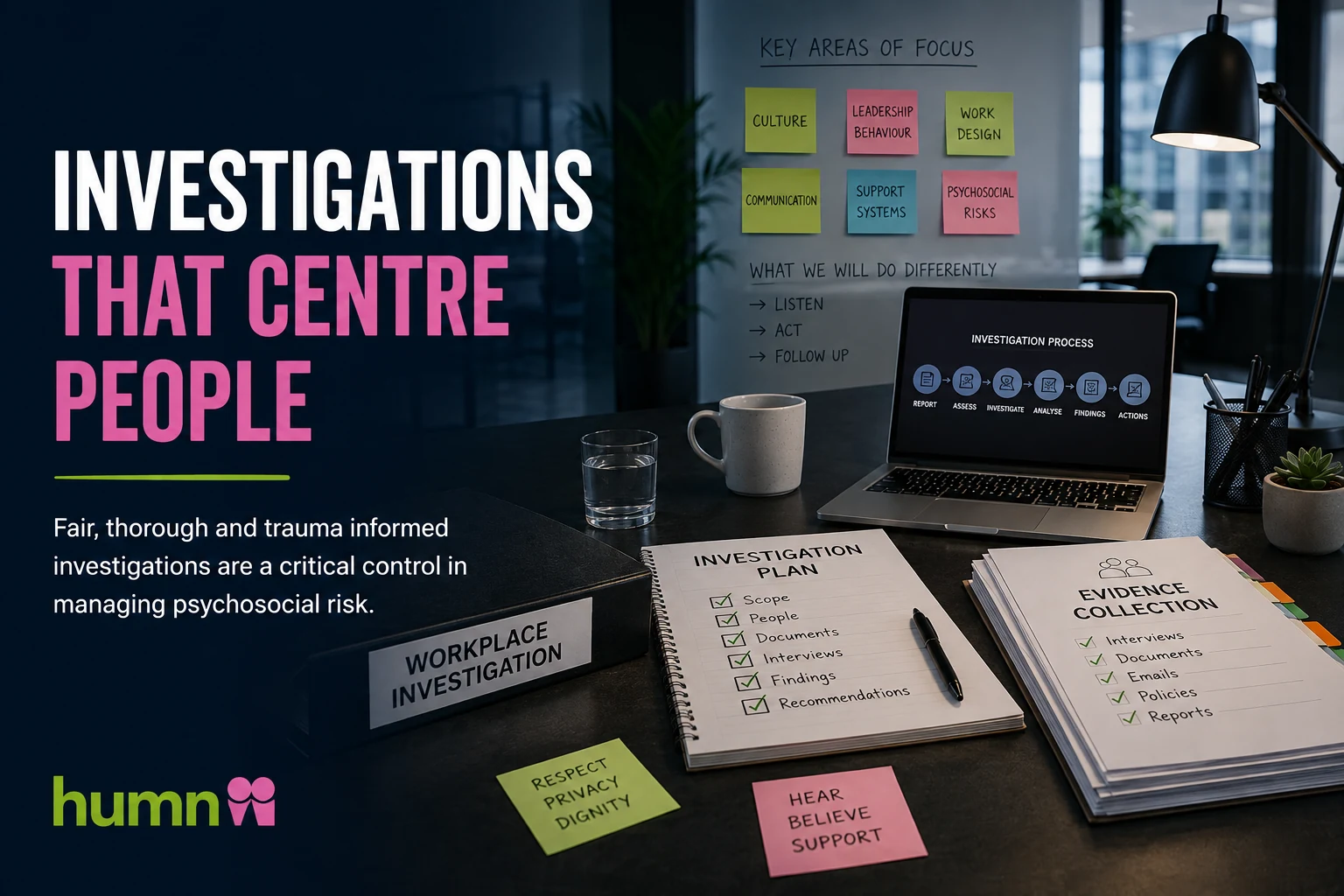
The Missing Piece in Psychosocial Risk: Investigations that Centre People
The spotlight is finally on psychosocial risks at work and rightly so. But awareness is only the first step.
What happens after someone speaks up?
What do you do when a psychosocial event unfolds in your workplace? How do you treat the person who has raised it? Who handles the investigation and how?
These are not just procedural questions. They are moments of truth that shape how psychologically safe your workplace really is.
Why Traditional Investigations Are Not Enough
Most organisations are used to applying conventional investigation models: ones built for clear-cut misconduct, not complex human harm. These models often fall short, and in some cases, cause even more damage especially when dealing with workplace sexual harassment, violence, discrimination, or bullying.
They are also ill equipped to respond sensitively when young or vulnerable workers are involved, such as apprentices or under 18 casual staff.
Put simply: traditional investigative methods can unintentionally retraumatise the very people they are meant to support.
It is time for a People Centred Approach
Organisations are now expected to assess and manage psychosocial hazards, but knowing your risks is not enough. You also need a response model that is safe, structured, and people led.
At Humn, we believe in a people-centred approach. This builds on the victim-centred principle used in psychosocial literature, such as the Respect@Work Report, but goes further. It recognises that others, like witnesses, bystanders, and even team members can be harmed by workplace events, and that the process itself must protect everyone involved.
What Does a People-Centred Investigation Look Like?
A people-centred model keeps the individual who raised the concern at the heart of the process. It means:
- They choose how to report and to whom
- They are involved in discussions about how the issue is handled
- Their safety, dignity, and autonomy are respected throughout
This does not mean the person decides the outcome or disciplinary action. Organisations still have legal obligations and a duty of care to all workers. But it does mean their voice matters at every step.
Key Considerations for a Psychosocially Safe Investigation
- A trained responder or investigator
- Offering a same-sex investigator, or a person of their choosing
- Allowing a support person with clearly defined responsibilities
- Ensuring a guardian or carer is present for young or vulnerable workers
- Minimising the number of people in the interview
- Building genuine rapport before asking sensitive questions
- Considering how, where, and how long the conversation takes
- Clear communication around closure, next steps, and outcomes
- Access to ongoing support
Filling the Capability Gap
Across many workplaces, we have seen a significant gap in investigative capability when it comes to psychosocial risks. That is why at Humn, we have designed specialised training based on experience across law enforcement, safety, HR, psychology and strategic interview methodology.
We equip your organisation to respond well when it matters most.
Know your hazards. Understand your risk. Prove your controls.
Humn helps organisations turn psychosocial risk into clear action, stronger controls and evidence leaders can use.
Talk to Humn