
Which controls must work to prevent harm?
Focus attention on the controls that matter most. Define what they must do, check their performance and act when they fail.
What is a critical control?
In critical control management, a critical control is selected because of its importance in preventing a material unwanted event or reducing its consequences. Humn applies this approach to psychosocial risk. The selection needs to be justified for the work and risk involved.
The ICMM guidance provides a management method for defining performance, ownership and verification. It originates in mining and metals; applying it to psychosocial risk is an adaptation, not a claim that every WHS jurisdiction requires this terminology.
Start with the work. Keep support in place.
Primary controls aim to prevent harm by removing hazards or changing the conditions that create exposure. Individual support matters, but it cannot carry the job of making the work safe.
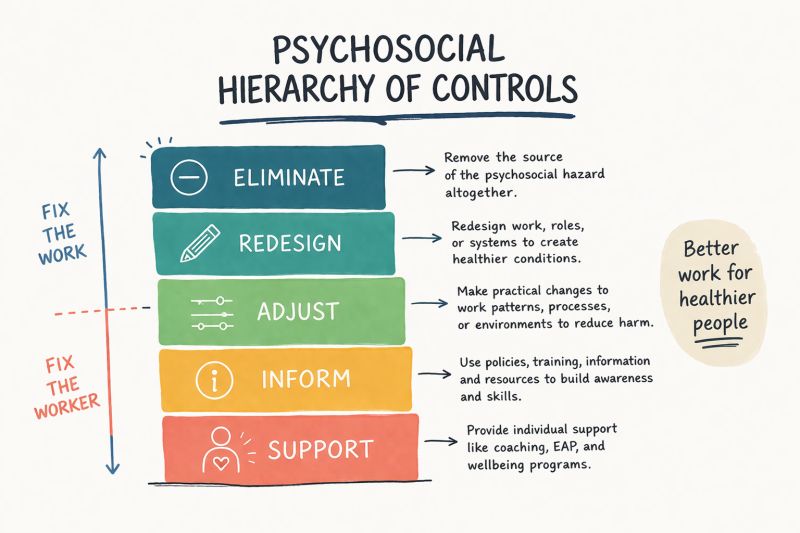
Primary: prevent harm
Remove the source of risk or redesign the work. Examples include matching workload to capacity, clarifying conflicting responsibilities, improving staffing and changing systems that expose workers to aggression.
Secondary: respond early
Recognise emerging distress and respond promptly. Practical training, early reporting and timely intervention can support workers and leaders. Use these alongside changes to the work.
Tertiary: support recovery
Provide care and recovery support when harm has occurred. EAP counselling, treatment and supported return to work can help the person, while the organisation addresses the underlying hazard.
An Employee Assistance Program can offer confidential support when a person is distressed or recovering from harm. It can also be accessed earlier; people do not need to wait for an injury. Its role depends on the service and how it is used.
For example, counselling may support a worker affected by sustained excessive workload. It does not reduce the workload, fill a vacant role or change an unrealistic deadline. Those conditions need controls directed at the work itself.
Safe Work Australia distinguishes support services from measures that prevent exposure to workplace psychosocial risks. Read the regulator guidance on prevention and EAP. The primary, secondary and tertiary labels describe prevention and intervention aims; measures can serve more than one aim.
Define performance before you verify it
- Purpose: which unwanted event or consequence does the control address?
- Requirement: what must be in place, and when?
- Owner: who has authority to maintain the control?
- Evidence: what observation or record will show whether it works?
- Verification: who checks, how often and against what criteria?
- Response: what happens immediately if the control is absent or ineffective?
Examples to test against your work
- Excessive demands: a capacity limit and escalation process linked to staffing and service commitments. Check actual workload decisions and roster records.
- Remote or isolated work: a working contact and emergency response arrangement. Test contact coverage and response, with workers involved.
- Violence and aggression: practical separation, staffing and response measures suited to the setting. Check that the measures function during relevant shifts.
- Organisational change: consultation and a workload and role assessment before implementation. Check that worker feedback influenced decisions.
These are illustrative controls, not a universal control set. Assess your context, interactions and exposure before choosing measures.
Evidence means more than completion
A policy can state the expectation. Verification needs to establish whether the control operates in the work. Training and support services can contribute, but they should not substitute for addressing the source of risk.
Humn advisory supports control design. Humn IQ® supports the connection between risks, actions and evidence. Bring the results into your risk register and board reporting.
How effective are your controls?
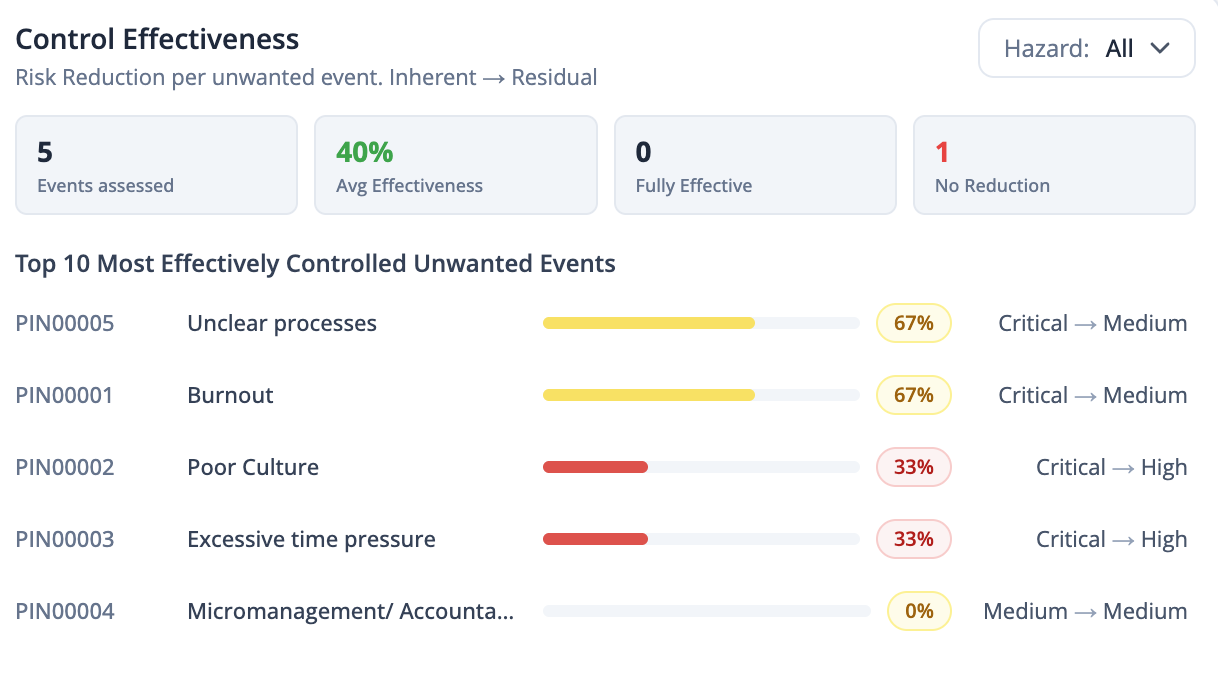
The control effectiveness view compares inherent and residual risk ratings for assessed unwanted events. Use it to identify where the assessment shows a reduction and where further attention is needed. Check these ratings alongside worker feedback and evidence that controls are operating as intended.
Your questions answered
Is every control critical?
No. Select the controls whose failure would materially affect the unwanted event or its consequences, and record the rationale.
Is a completed action evidence of effectiveness?
It shows implementation. Effectiveness needs evidence that the control achieves its intended purpose.
Does verification replace worker consultation?
No. Workers can explain whether controls are workable and where they fail. Use consultation alongside observations and records.
Sources and further reading
- Safe Work Australia: prevention controls and the role of support services
- Safe Work Australia: risk management and review
- ICMM: Critical Control Management Good Practice Guide, 2026
Requirements vary by jurisdiction. Check the law and approved codes applying to your workplace.
From assessment to evidence.
Looking for a People at Work alternative?
Build on what you already know about your workplace. Humn IQ® brings psychosocial survey information, risk assessment, controls and evidence together in one risk management system.
Explore guidePsychosocial risk. A clearer view from the boardroom.
Give directors and executives the information to ask useful questions, make informed decisions and follow through on psychosocial risk.
Explore guideA psychosocial risk register that leads to action.
Make the link between the hazard, the people exposed, the control and the evidence clear enough for someone to act on it.
Explore guideWhich controls must work to prevent harm?
Focus attention on the controls that matter most. Define what they must do, check their performance and act when they fail.
Explore guidePut the next step into practice.
Talk with Humn about your assessment, controls and evidence needs.
Book a Strategy Session