Psychosocial Safety Laws Apply Nationwide but One Size Definitely Does Not Fit All
The short version: EVERY Australian jurisdiction now requires you to proactively identify, assess and control psychosocial hazards in your workplace.
The catch? Each jurisdiction does it slightly differently, and in some states the differences are significant enough to change what you actually need to do.
We cut through the complexity so you know exactly where you stand.
Confused?
Let's start with the numbers that should get the attention of anyone running a business.
In March 2025, NSW Treasurer The Hon. Daniel Mookhey told parliament that the average cost of a psychological injury claim in NSW had risen from $146,000 in 2019-20 to $288,542 in 2024-25. Psychological claims make up 12% of total workers compensation claims in NSW but account for 38% of the total cost. Median time off work for a mental health claim nationally is 34 weeks and for physical injuries, it is 8 weeks.
Mental health claims are rising. Life insurers have called it an affordability and sustainability crisis. In 2024, mental health claims in Australia totalled $2.2 billion, up from $1.9 billion in 2019.
Regulators have noticed. Inspectors are visiting more workplaces, with SafeWork NSW publicly stating it expects a 25% increase in psychosocial inspection visits and any organisation with 200 or more workers in NSW can now expect a dedicated psychosocial WHS audit at some stage soon.
The legal framework underpinning all of this has now been completed. As of 1 December 2025, Victoria's new regulations came into effect, meaning every single Australian jurisdiction now has specific psychosocial safety obligations in force.
There are no more jurisdictions in transition or 'coming soon'.
This is not a wellbeing initiative. This is occupational health and safety law.
The foundation: what the law requires everywhere
The starting point is the same across almost every jurisdiction. As a PCBU (person conducting a business or undertaking), you have a positive duty to:
- Identify psychosocial hazards in your workplace before harm occurs
- Assess the risks those hazards create
- Implement control measures to eliminate or minimise those risks, so far as is reasonably practicable
- Consult with workers in doing so
- Measure your controls to test if they are effective and positively impacting your hazards/risks
- Review your controls when things change, incidents occur or workers raise concerns
The important word in all of that is proactive.
You do not wait for an injury to happen and then respond. You look at how work is designed, how it is managed, what behaviours exist in your workplace and what the environment is like - and address the risks you find.
The [17 psychosocial hazards](https://www.comcare.gov.au/safe-healthy-work/prevent-harm/psychosocial-hazards) identified by the Comcare and Safework Australia's [Model Code of Practice: Managing psychosocial hazards at work](https://www.safeworkaustralia.gov.au/doc/model-code-practice-managing-psychosocial-hazards-work) give a useful working lists and actions to follow. They include high or low job demands, poor support, lack of role clarity, poor change management, inadequate reward and recognition, bullying, harassment, violence, remote or isolated work, traumatic events, poor organisational justice and workplace conflict. The Commonwealth Code adds three that are specific to its jurisdiction being fatigue, intrusive surveillance and job insecurity.
Key point for directors: Your WHS obligations extend to psychological health, not just physical safety. A board that governs WHS without explicitly addressing psychosocial risk is not meeting its duty.
The obligation sits with officers of a PCBU, not just the safety team.
Where it gets complicated and the differences that matter.
Here is where most leaders get stuck.
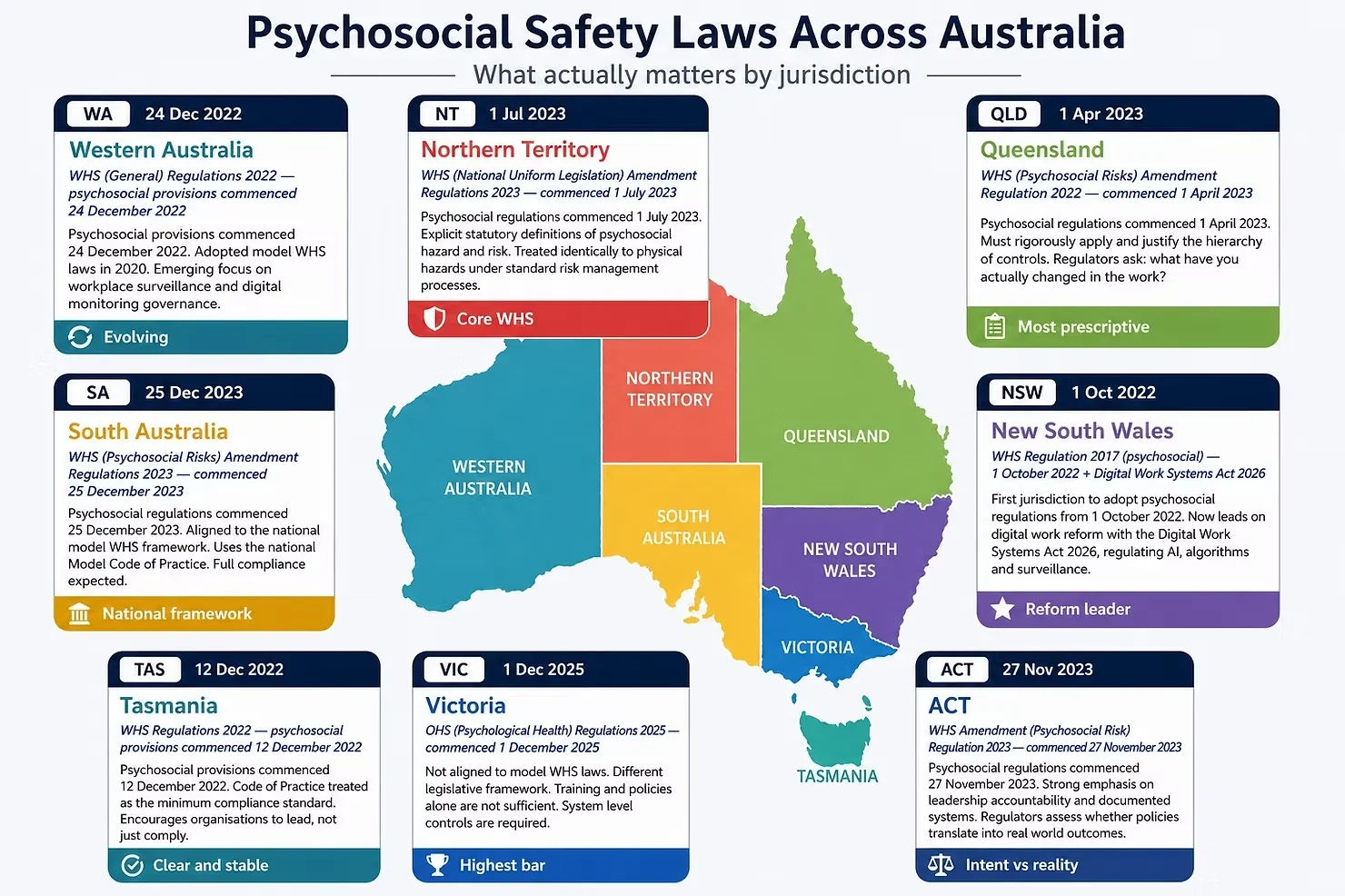
The national headlines say 'Australia now has psychosocial safety laws'. But what that means in practice depends on where your people work. The map of Australia above summarises the key facts and the sections that follow explain some of the differences that have real operational consequences.
Victoria: the jurisdiction that does it differently
Victoria is not on the national model WHS laws. It operates under the Occupational Health and Safety Act 2004 (Vic) and its new Occupational Health and Safety (Psychological Health) Regulations 2025, which came into effect on 1 December 2025.
The differences from other jurisdictions are more than administrative. Victoria's definition of a psychosocial hazard is broader and more explicit. It covers work design, systems of work, management practices, personal and work-related interactions, and factors that arise in the working environment. Gendered violence and vicarious trauma are specifically recognised in Victoria's compliance guidance.
The most significant operational difference is how Victoria treats training and information as controls. In every other jurisdiction, you can use training as part of your response to a psychosocial risk. In Victoria, training and information cannot be your only control and they cannot even be your predominant control, unless there is genuinely no other reasonably practicable option. This is a direct response to years of employers ticking a box with an online module and calling it done.
Practical implication
If your current psychosocial response in Victoria is primarily a training program, an EAP or a policy document, it is very likely insufficient under the 2025 Regulations. You need higher-order controls such as workload redesign, supervision structures, staffing levels, physical environment changes or systemic changes to how work is organised.
Queensland: the most prescriptive harmonised jurisdiction
Queensland adopted the model psychosocial regulations in April 2023 and is widely regarded as the most compliance-focused of the harmonised jurisdictions. Unlike most other states, Queensland explicitly requires PCBUs to apply the full hierarchy of controls when managing psychosocial hazards, the same rigorous process you would apply to a physical hazard like a chemical exposure or a fall risk.
Queensland also goes further than any other jurisdiction on harassment. Employers must proactively identify psychosocial hazards and risks associated with sexual harassment and sex or gender-based harassment at work, and must prepare and implement a written plan to manage those risks. A policy alone does not satisfy this requirement. The plan must exist as a discrete, documented instrument.
WorkSafe Queensland has integrated psychosocial hazards into its inspection and audit checklists. When an inspector visits, they will ask to see the rationale for your chosen controls, not just confirmation that controls exist. If you have people working in Queensland, the question is not whether you have a harassment policy. It is whether you have a plan.
Practical implication
In Queensland, 'we have an EAP and a bullying policy' will not satisfy an inspector. You need documented risk assessments, a clear rationale for why your chosen controls are appropriate, and a process for reviewing them when incidents occur or new information arises. And if sexual harassment or sex or gender-based harassment is a foreseeable risk in your workplace (and in most workplaces, it is) you also need a standalone written plan for managing those specific risks. That plan needs to name the hazards, the controls, and the person accountable for them.
New South Wales: the first mover on AI and digital work
NSW has the most active regulatory posture in the country right now. The WHS Regulation 2025 replaced the 2017 Regulation and consolidated psychosocial obligations into a cleaner framework. The hierarchy of controls is explicitly mandated.
But the development that will affect the most organisations going forward is the Work Health and Safety Amendment [(Digital Work Systems) Act 2026](https://www.bing.com/ck/a?!&\&p=cf4bfb9c768624d2e2cfdf794d027fe96e75acdd33c367c38647461d52aaae2eJmltdHM9MTc3NzE2MTYwMA\&ptn=3\&ver=2\&hsh=4\&fclid=2349ddd0-fd98-6ae3-3c0a-cbf3fc4d6b8e\&u=a1aHR0cHM6Ly93d3cucGFybGlhbWVudC5uc3cuZ292LmF1L2JpbGwvZmlsZXMvMTg4NDcvUGFzc2VkJTIwYnklMjBib3RoJTIwSG91c2VzLnBkZg), passed by the NSW Parliament on 12 February 2026. This is the first law of its kind in Australia and possibly the world.
The Act amends the WHS Act 2011 (NSW) to make explicit that an employer's duty of care covers the health and safety risks created by digital work systems. A 'digital work system' means any algorithm, artificial intelligence, automation or online platform used in the conduct of a business.
This captures automated rostering tools, AI-driven performance management, gig economy platforms, digital scheduling systems and any other technology that allocates work, monitors performance or tracks workers. The psychosocial risks it targets are specific such as excessive workloads created by algorithmic work allocation, unreasonable performance metrics, excessive monitoring or surveillance and discriminatory decision-making by automated systems.
Unions have also been granted right of entry to inspect digital work systems where a WHS breach is suspected, conditional on SafeWork NSW publishing guidelines on how that access works. Those guidelines had not been issued as at April 2026.
This NSW law has national implications. Safe Work Australia has been directed to consider whether the national model WHS laws should be amended to address the same subject. Leaders using AI tools to manage, schedule, or monitor workers anywhere in Australia should be preparing now, not waiting for their state to legislate.
Commonwealth (Comcare): the federal framework
The Comcare jurisdiction covers national corporations, Commonwealth government entities and self-insured licensees. If your organisation is in this category, the Work Health and Safety Act 2011 (Cth) and the WHS Regulations 2011 (Cth) apply, along with the Managing Psychosocial Hazards at Work Code of Practice 2024.
The Commonwealth Code identifies 17 psychosocial hazards and adds three that are specific to the federal jurisdiction - fatigue, intrusive surveillance and job insecurity. This is worth noting, because it signals a clear regulatory intent that technology-driven surveillance and precarious employment arrangements are not outside the scope of your psychosocial obligations.
Penalties under the Commonwealth WHS Act are now indexed to the Consumer Price Index each year from 1 July.
[An industrial manslaughter](https://www.holdingredlich.com/update-industrial-manslaughter-offences-across-australia)[ offence ](https://www.aihs.org.au/Web/Web/Advocacy-Media/All-News/2024/06-June/How%20are%20employers%20and%20regulators%20responding%20to%20industrial%20manslaughter%20laws.aspx)also came into force from 1 July 2024, carrying penalties of up to $18 million for corporations and 25 years imprisonment for individuals.
What this means for you as a leader or director
Stop treating psychosocial safety as an HR function
This is a WHS obligation and WHS obligations are officer obligations. Under the model WHS Act, an officer of a PCBU has a positive duty to exercise due diligence to ensure the PCBU complies with its WHS duties. That means actively acquiring and keeping up to date with WHS knowledge, understanding the nature of the operations and associated hazards and ensuring the PCBU has appropriate resources and processes.
That duty applies to psychosocial hazards just as it applies to physical ones.
A board or executive team that reviews physical safety metrics but has no visibility over psychosocial risk is not discharging its officer duty.
Know which jurisdiction your people work in
If your organisation operates across multiple states, you are operating across multiple regulatory regimes. A national policy document is a starting point, not a solution. You need to understand which framework applies in each location and whether your controls are sufficient under that framework, not just the most permissive one.
For most organisations, the practical consequence of this is reviewing your controls against the Victorian standard (because it is the most demanding on the question of what counts as an adequate control) and the NSW standard (because it is the most advanced on digital work systems). If you have people working in Queensland, add a third lens! Queensland is the only jurisdiction that requires employers to prepare and implement a written plan specifically for managing psychosocial risks associated with sexual harassment and sex or gender-based harassment at work. A policy is not enough. A documented plan is a distinct legal requirement.
Policies are not controls
This is the most common gap we see. Organisations have a bullying and harassment policy, a flexible work policy and a psychosocial safety framework document. Those things matter, but they are not controls.
A control is something that changes the way work is designed, organised or managed so that people are less exposed to the hazard in the first place.
A policy that says 'we do not tolerate bullying' does not reduce the risk of bullying occurring. A control that addresses the risk of bullying might include workload redesign to reduce stress that drives poor behaviour, clearer role design to reduce conflict, more structured supervision for people in high-risk roles or changes to team composition.
Regulators in every jurisdiction are now asking 'what have you actually done to change the conditions that give rise to this hazard'? The answer needs to go beyond documentation.
The 17 hazards are a diagnostic, NOT a checklist
The 17 psychosocial hazards identified in the Code of Practice are a useful starting point for understanding what you need to look for. But compliance is not a matter of going through the list and confirming each one is addressed. The question is whether the specific hazards present in your specific workplace, for your specific workforce, are being effectively managed.
A financial services firm faces different psychosocial risk profiles than a construction company or a disability services provider. High job demands look different for a frontline emergency worker than for a remote knowledge worker.
Your risk assessment needs to reflect the actual work your people do.

The road ahead: what to watch
- Safe Work Australia is now considering model law amendments on digital work systems following the NSW legislation. Other jurisdictions, including Victoria, have signalled interest in digital surveillance governance. This is coming nationally.
- Regulatory bodies across all jurisdictions have signalled increased inspection activity. The era of voluntary compliance in psychosocial safety is over.
- NSW has tightened eligibility for ongoing mental health injury payments and introduced new employer excess. Other jurisdictions are watching the outcomes closely.
- Regulators are increasingly asking not just what controls exist, but whether they work. Organisations that can demonstrate systematic measurement, monitoring, and evidence of effectiveness will be better positioned in enforcement scenarios.
The good news:
Organisations that have already built systematic psychosocial risk management into their WHS frameworks and are proactively and actively managing it are not just compliant. They report lower turnover, fewer claims, stronger staff engagement and better leadership outcomes.
Psychosocial safety done well is not a cost. It is a competitive advantage.
It is worth asking 'what is the cost if we get this wrong or hide our heads in the sand'
Humn works with organisations across Australia to build psychosocial safety systems that are legally sound, practically effective and evidence-based.
If you want to understand where your organisation stands against the current regulatory landscape, we would be glad to help.
Visit [www.humn.global](http://www.humn.global) or contact us at [hello@humn.global](mailto\:hello@humn.global).
Know your hazards. Understand your risk. Prove your controls.
Humn helps organisations turn psychosocial risk into clear action, stronger controls and evidence leaders can use.
Talk to Humn