top of page
Search

Psychosocial Safety Board Briefings-The Case That Every Company and Board Director Must Know


In September 2025, the Victorian County Court handed down a decision that every Australian director should read and definitely understand.


Board of Directors must assess and manage Psychosocial Risks

A delivery driver for a logistics company died in August 2022 when his van drifted into the path of an oncoming truck. He had been working a 12-hour overnight shift. It was his 17th consecutive night on the same 796-kilometre route. Here's where things went very wrong:

  • No rotation.

  • No relief driver.

  • Inadequate rest between shifts.


WorkSafe Victoria investigated and found that the company had no system to manage fatigue. Not an inadequate system. No system at all. No rostering controls. No rest break enforcement. No fatigue training.

Absolutely Nothing.


The penalties handed down on 22 September 2025 were:

  • The company for recklessly endangering a worker: $1,100,000

  • The company for failing to provide a safe workplace: $250,000

  • The director personally, for failure of duty as an officer under the OHS Act s.144(1): $80,000

  • Combined total: $1,430,000

"Some directors still believe their D&O policy will cover them if a WHS penalty lands. In most Australian jurisdictions, it will not. The fine comes out of your pocket. Personally."

The director's defence, that he did not know, was not accepted. It never is.

Beyond the fine, the court issued an adverse publicity order requiring the company and the director to publicly advertise the offence, its consequences and the penalty in an industry publication.

In 2026, the company entered liquidation, leaving creditors more than $2 million out of pocket.

"The company cannot pay your fine. The law prohibits it. That $80,000 the director received was his to carry. Alone."

A fatality, a $1.43 million penalty, a personal conviction and a collapsed business. All because fatigue, a recognised psychosocial hazard under the WHS Act and the Model Code of Practice 2024, was not managed.


This case is not an outlier. It is a preview of what regulators are willing to pursue when systems are absent and officers have not exercised due diligence.


"Industrial manslaughter now attracts up to 20 years imprisonment for an individual. There is no policy that covers that."
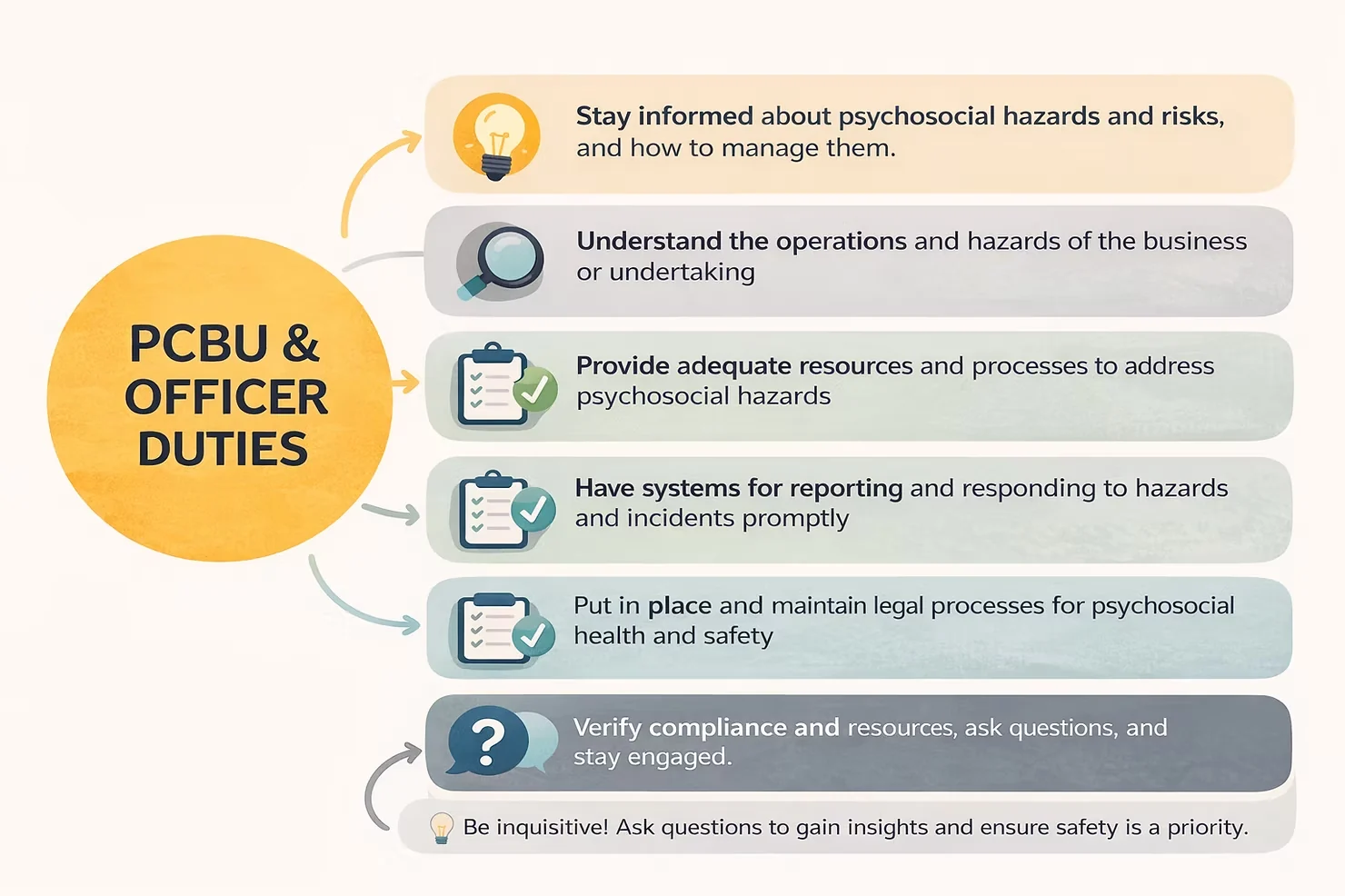
PCBU Officer Duties
PCBU Officer Duties

What Boards Are Getting Wrong? No Psychosocial Safety Board Briefings


When we work with boards, we ask three direct questions. The answers reveal a great deal.


Are Psychosocial Safety Board briefings on your agenda at every meeting? 

Not as an incident report, as a standing governance item with lead indicators, trend data and visibility of controls. If the answer is no, your board is not meeting its obligations, and it is also not getting the information it needs to ask the right questions.


Do you understand the dashboards and reports management is giving you? 

This is not a judgment, it is a practical problem. If the board cannot interpret what the data is showing, they cannot assess whether the organisation's risk management is working. A risk score without context is meaningless and a maturity rating without benchmarks tells you nothing. Boards need to understand what they are looking at and organisations need to ensure that reporting is designed for governance, not just compliance.


If something went wrong tomorrow, could you demonstrate that the board had genuine oversight of psychosocial risk? 

Not that a policy existed, not that an EAP was available but the board had line-of-sight to the hazard profile, asked questions about controls and held management accountable for the system and measuring their effectiveness.

For most boards we work with, the honest answer to all three questions is not yet or probably not.

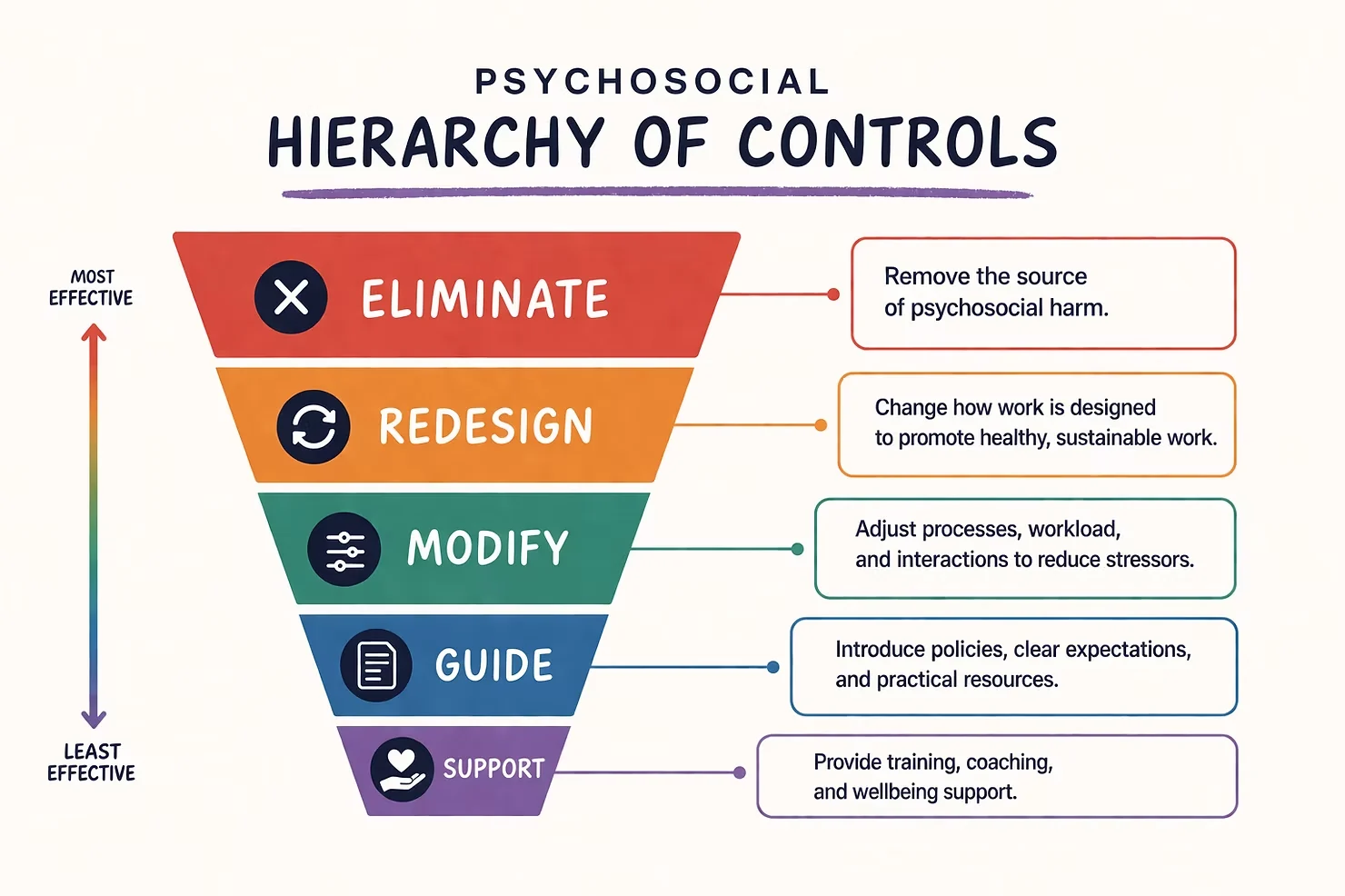
Humn - Hierarchy of Controls

Doing nothing is Not a Risk Strategy

We understand the competing pressures boards face, our team are Non-Executive Directors on boards too.

Governance agendas are full, psychosocial safety feels less tangible than financial performance or physical safety and there is a persistent belief that if staff seem fine, the risk must be low.


That belief is VERY dangerous.


This case did not begin with a crisis, it began with an absence.

  • An absence of systems.

  • An absence of oversight.

  • An absence of the questions that a diligent officer should have been asking.

The driver worked 17 consecutive nights on the same route without anyone in a position of authority intervening or conducting a wellness check.


That is a governance failure, not just an operational one.

Psychosocial risk does not announce itself in the same way a broken piece of equipment does. It accumulates, it compounds and when it surfaces, it is often because something irreversible has already occurred.


The legal framework does not allow boards to say they did not know, it requires them to have known, to have asked and to have acted.


Safework SA root causes of psychosocial hazards

What Good Governance Looks Like


From our work across multiple sectors, here is what effective board-level governance of psychosocial risk actually looks like:

  • A safety management system that incorporates psychosocial risk alongside physical risk.

  • Clear roles, responsibilities and accountability for WHS performance.

  • Robust board reporting on hazards, controls, incidents and trends, including lead indicators, not just lag indicators.

  • Strong worker consultation processes, so the organisation's hazard intelligence is grounded in actual worker experience.

  • Policies and more importantly training on these policies, that address expected behaviours, escalation pathways and bystander responsibility.

  • Fair, transparent HR and investigation processes that do not create secondary harm.

  • And, critically, WHS as a standing agenda item at every board meeting, Not a tick-box but a genuine governance conversation.


Humn Board Briefings and Training

At Humn, our board work is designed to move directors from awareness to accountability. That means helping them understand the legal landscape, mapping the specific hazard profile of their organisation and building the governance muscles they need to ask better questions and hold management to account.


We are also working with executive and senior leadership teams across sectors including NFP, construction, local government, disability and aged care, legal and infrastructure. What we consistently find is that the hazards are not surprising once they are named. What is surprising is how long they have been present without formal systems to manage them.

The question boards need to sit with is not whether their people care. The question is whether their system is designed to protect them.


A fine does not fix a fatality. But a system might prevent one.

Humn works with boards, executives and teams to identify, manage and govern psychosocial risk. 


For information about our BoardReady program or board awareness sessions, contact us at hello@humn.global or visit www.humn.global.


Humn IQ
Humn IQ to Assess and Manage Psychosocial Risks

Trigger Warning: This blog references a case involving the death of a worker. If you or someone you know is experiencing distress, please contact Lifeline on 13 11 14 or Beyond Blue on 1300 22 4636.


Comments


Human-Focussed
Psychosocial Safety

System

  • Youtube
  • Instagram
  • LinkedIn

Contact Information

Humn

We acknowledge the Traditional Owners of Country throughout Australia and acknowledge their continuing connection to land, waters and community. We pay our respects to the people, the cultures and the Elders past and present.

Disclaimer: The information provided by Humn is for general informational and educational purposes only. While we strive to ensure accuracy and alignment with current workplace safety regulations, our content does not constitute legal, medical, or professional advice. Organisations should seek independent legal or professional guidance before making workplace health and safety decisions. Humn certification demonstrates a commitment to workplace well-being but does not guarantee regulatory compliance or eliminate workplace risks. Humn is not liable for any decisions made based on our resources, training, or certification process.By engaging with our services, website, or communications, you acknowledge and accept this disclaimer.

© 2025 Humn Global. All rights reserved.

bottom of page