The Process Is the Hazard. Four Decisions Every Leader Needs to Read.
You can run a completely legitimate performance process. You can have every policy documented and signed off. You can genuinely believe you are doing the right thing.
And you can still end up in front of a regulator.
Four decisions handed down in Australia between 2025 and 2026 are sending the same message. It is not just what you do when managing performance, conducting an investigation, or restructuring your workforce. It is how you do it. And the how is now subject to your WHS duty of care.
The Department of Defence: a conviction, not a notice and poor Psychosocial Safety
In December 2025, the Department of Defence became the first Commonwealth employer in Australia to be convicted and fined for failing to manage psychosocial risks relating to the death of a worker. A 34-year-old RAAF technician took his own life while on duty at RAAF Base Williamtown. Defence pleaded guilty under section 33 of the Commonwealth WHS Act.
The worker had been placed on four separate performance management Work Plans over six months. Despite displaying increasing signs of distress throughout that process, his supervisors did not refer him for support, place him on leave, or take any steps to relieve the pressure he was clearly experiencing.
Defence admitted it breached its primary duty by failing to provide training for supervisors involved in the use of the performance management tool. The Court fined the Department $188,000 and issued an adverse publicity order.
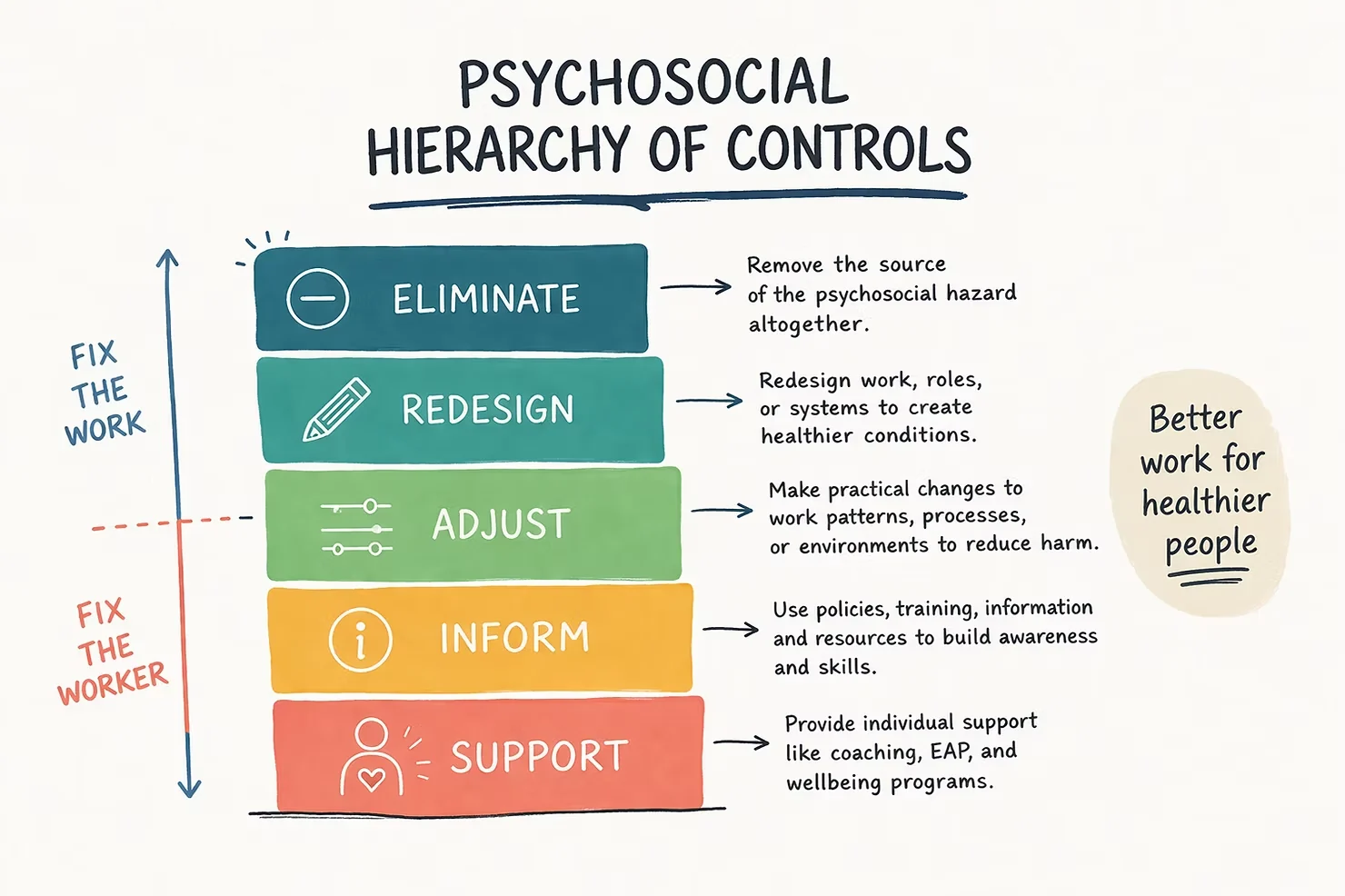
A document in a folder is not a control.
University of Technology Sydney: 800 staff, one day's notice, a prohibition notice
In September 2025, SafeWork NSW issued a prohibition notice to UTS, halting a proposed restructure involving approximately 150 job losses. The notice cited serious and imminent risk of psychological harm to 800 staff who were called to a change meeting with just one day's notice.
The notice found that UTS gave staff inadequate time to prepare, promised additional supports without explaining how to access them, and scheduled the meeting before feedback from its own psychosocial risk assessment had been considered.
The restructure was not illegal. What created the exposure was the absence of genuine, timely consultation and the failure to treat the change process itself as a foreseeable psychosocial hazard requiring active management.
Consultation is not a formality. Under WHS law, it is a duty.
NSW Department of Education: the investigation was the hazard
In NSW DoE v SafeWork NSW (No 2) [2026] NSWIRComm 1014, the NSW Industrial Relations Commission upheld two improvement notices against the Department of Education following a misconduct investigation that ran for over ten months.
The employee received no upfront timeline. Communication was sporadic and poorly documented. The duties she was assigned while the process ran were well below her substantive role level.
Commissioner O'Sullivan confirmed what many leaders have resisted accepting: a misconduct investigation is itself a psychosocial hazard. The duty to manage risk to the person being investigated does not disappear because the investigation is justified.
One specific finding worth noting is role underload. Assigning someone holding duties that are meaningless or well below their capability is a recognised psychosocial hazard in its own right.
At the time the notices were issued, the Department had 606 active investigations with 46 running for more than two years.
This was not a single failure. It was a system of work that was fundamentally inadequate.
Heidel [2026] FWC 893: the case that changes the conversation
In Heidel [2026] FWC 893, a University of Notre Dame Australia employee applied for stop-bullying orders after her manager questioned incomplete work, raised performance and accountability concerns, flagged a potential Performance Improvement Plan, and indicated that remote working arrangements may be reviewed.
The Commission was unequivocal. This was reasonable management action, carried out reasonably. The communications were professional and evidence-based. The Commission stated clearly that a worker cannot avoid scrutiny of their performance by characterising it as bullying.
Psychosocial safety is not achieved by avoiding managing people. It is achieved by doing it well.
What these four cases say together
Employees under investigation or significant role change should receive a clear timeframe at the outset, with regular documented communication throughout.
Alternative duties must reflect the person's role level, skills and dignity.
The process itself, whether investigation, performance management or restructure, must be subject to a psychosocial risk assessment.
Supervisors must be trained, not just briefed.
What boards and executives must assure
From an officer due diligence perspective, these four decisions require active assurance, not assumption.
- Can you demonstrate that your performance management frameworks are robust, consistent and defensible?
- That your investigation processes are time-bound, transparent and risk-controlled?
- That the leaders responsible for running these processes are actually trained and capable of doing so safely?
The question is not whether your duty exists. It is whether you can demonstrate you are meeting it.
Enter Humn
Humn helps organisations get ahead of exactly these exposures, before a complaint is lodged, before a notice is issued, and before someone is harmed.
Talk to the Humn team or explore Humn IQ® to understand and manage psychosocial risk.
Content note: This article references the death by suicide of a worker.
Know your hazards. Understand your risk. Prove your controls.
Humn helps organisations turn psychosocial risk into clear action, stronger controls and evidence leaders can use.
Talk to Humn